Wednesday, November 20, 2019
Lupine Publishers: Lupine Publishers | Evaluation of Host Associated ...
Lupine Publishers: Lupine Publishers | Evaluation of Host Associated ...: Lupine Publishers- Environmental and Soil Science Journal Abstract The water quality of many waterways in the state of ...

Monday, November 18, 2019
Lupine Publishers: Lupine Publishers| Waste to Worth - Sludge Contain...
Lupine Publishers: Lupine Publishers| Waste to Worth - Sludge Contain...: Lupine Publishers- Trends in Civil Engineering and its Architecture Opinion Human activities on earth produce in considerabl...
Friday, November 15, 2019
Lupine Publishers | Pre-cochlear Implantation Aural/Oral Rehabilitation, Is it Mandatory?
Lupine Publishers | Journal of Otolaryngology Research Impact Factor

Abstract
Purpose: The aim of this study is to compare the functional benefit of the communicative skills of children with CI without pre-implantation aural/oral rehabilitation in relation to those with CI with pre-implantation 6 months aural/oral rehabilitation in order to compare the role of pre-implantation aural/oral rehabilitation on the communicative abilities of severe to profound and profound sensorineural hearing impaired children.
Method: This study has a prospective design. It started after final diagnosis and decision that all children are candidates for CI but half of them are fitted with behind the ear hearing aids and the other half of children are immediately implanted provided that the primary language assessment before rehabilitation is present in the medical files of these children. A 2nd language assessment was done after 12 months of language therapy to detect the progress of the language development. These sixty patients were divided into two groups:
a) Group A: Thirty children, who have used behind the ear hearing aids for one year before CI and attended regular language therapy.
b) Group B: Thirty children, who shifted immediately to cochlear implantation, and were enrolled in auditory training and language therapy for one year.
Results: Total language age of children using cochlear implant without pre-implantation aural/oral rehabilitation is significantly higher than that in the children while using hearing aids for one year before CI. Also, there is highly significant difference between frontal and back speech sounds in the children after immediate implantation with positive correlation.
Conclusion: Cochlear implant is safe & reliable technique. The fact that many profoundly hearing impaired children using immediate cochlear implant without pre-implantation aural/oral rehabilitation can develop functional levels of speech perception & production, develop competency level in a language other than their primary language and continuation of language therapy together with proper mapping accordingly is a must to enroll these children in main stream education.
Keywords: Hearing Aids; Cochlear Implant; Language; Speech Intelligibility Pre-implantation Rehabilitation
Abbreviations: SNHL: Sensorineural Hearing Loss; HA: Hearing Aids; CI: Cochlear Implantation
Introduction
Objectives
Subjects & Methods
a) Group A: Thirty children, who have used behind the ear hearing aids for one year and attended regular language therapy despite those children, are candidates for cochlear implants.
b) Group B: Thirty children, who shifted immediately to cochlear implantation and had regular language therapy and were enrolled in auditory training.
Half patients were fitted with bilateral powerful digital signal processing BEHAs and used them for at least a 12-months period before CI. Hearing aid use was determined by parental and therapist reports. After surgical implantation of the device and an adequate healing period for the other half of the patients, the implants were activated (usually 4 weeks after surgery). The children were fitted with one of the two brands of speech processors using a behind the ear controller. Speech processors used in this study were OPUS 2 with standard Sonata electrode & Cochlear Freedom Processor with nucleus 24 k straight electrode.
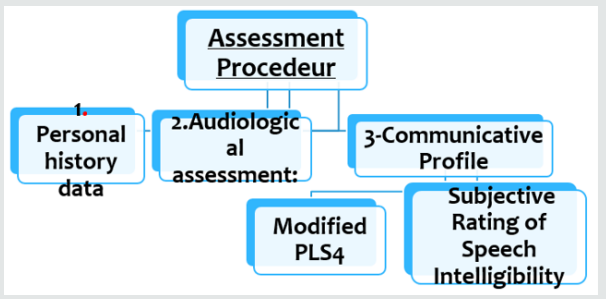
In this study using Modified Preschool Language Scale & Subjective Speech Intelligibility Test gave us a summary of the improvement of these children. This is matched with other studies which focused that both comprehension and expression of spoken language are important markers of parent-perceived success of a CI (Figure 1).
Figure 1
Language Improvement Quotient: The language
improvement quotient [8] was used to compare between the
rates of progress in language in order to overcome the bias of age
matching between the individuals in the study.Language Improvement = 2nd language age -1st language age divided by duration of language rehabilitation.
a) A1 refers to language development of group (A) after using bilateral behind the ear hearing aids for 12 months which is calculated by this equation:
A1= 2nd language age -1st language age divided by 12(duration of rehabilitation)
b) B1 refers to language development of group (B) after using unilateral CI for 12 months which is calculated by this equation: B1= 2nd language age -1st language age divided by 12(duration of rehabilitation).
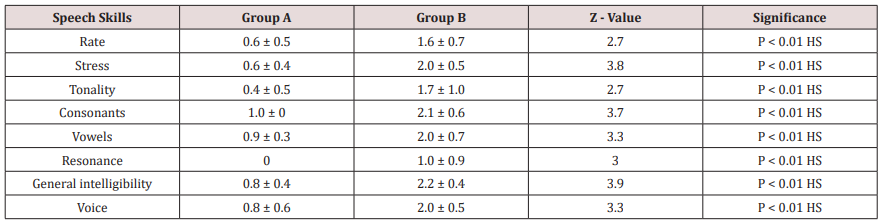
Speech analysis was performed using the Ain Shams assessment protocol which includes analysis of supra-segmental phonology (rate, stress and tonality), segmental phonology (consonants and vowels), nasal resonance and general intelligibility of speech. Assessment of auditory perception skills was performed evaluating a hierarchy of listening skills ranging from detection, to discrimination, identification, recognition and comprehension. Assessment of speech reading abilities was done and expressed as percent change over time.
Statistical Studies
Data was analyzed using SPSS, Statistical Package for the Social Sciences version 17 (SPSS Inc., Chicago, IL). Numerical data were expressed as mean, standard deviation, and range. For quantitative data, comparison was done using Mann-Whitney test (non-parametric t-test). A p-value < 0.05 was considered significant. Spearman-rho method was used to test correlation between numerical variables (r > 0.3 = no correlation, r = 0.3-0.5 = fair correlation, r = 0.5-0.1 = good correlation).Results
a) Age
b) Gender.
c) Incidence of hearing loss.
d) Psychometric evaluation.
e) Pure tone Audiometry.
f) First language age.
g) Radiology.
a) Age Distribution: Both groups are matched according to age. In group (A) the age of the children ranged between 3 years and 7years. In group (B). The age of the children ranged Between 3 years & 7 years, provided that all children were implanted before the age of 6 years.
b) Gender: No significant difference was noted in gender of both groups.
c) Incidence of Hearing Loss: In group (A) there were 24 children (80%) with congenital hearing impairment and 6 children (20%) with acquired hearing loss, while in group (B) there were 18 children (60%) with congenital hearing impairment and 12 children (40%) With acquired hearing loss.
d) Psychometric Evaluation: All children in group (A) had normal psychometric evaluation with a mean Value 87.5± 4.6; also, in group (B) all children had normal psychometric Evaluation with a mean value 86.4±5.1.
e) Pure Tone Results: Pure tone results of group (A) maintained a mean value of 27.9 dB HL. Group (B). Decreased in mean values from 65.7±8.2 dB HL. There was a highly significant difference (P=0.001) between group (A) and group (B) in favor of group (B).
f) First Language Age: Before start of therapy, both groups had no passive vocabulary and were Nonverbal. They used either babbling or vocal play.
g) Radiology: All Children both in groups (A) and (B) were having normal CT and MRI of Petrous bone.
Tables 1-3 demonstrate the progress of the language abilities, the auditory abilities and the speeding reading abilities of both groups, respectively, from the time just prior to the rehabilitation (either oral\ aural in group A or aural in group B) as compared to the evaluation done one year the rehabilitation (Table 4).
Table 1: Results of collective language improvement in both groups using paired-T test.

Table 2: Results of progress in speech reading ability before and after rehabilitation in the 2 groups (using Paired-T test).

Table 3: Difference in the speech ratings between the 2 groups after 3 years of rehabilitation (using Mann-Whitney test).

Table 4: Results of collective language improvement in both groups using paired-T test.
Discussion
Conclusion
For more Lupine Publishers Open Access Journals Please visit our website: h
http://lupinepublishers.us/
For more Journal of Otolaryngology-ENT Research articles Please Click Here:
https://lupinepublishers.com/otolaryngology-journal/
To Know More About Open Access Publishers Please Click on Lupine Publishers
Follow on Linkedin : https://www.linkedin.com/company/lupinepublishers
Follow on Twitter : https://twitter.com/lupine_online
Wednesday, November 13, 2019
Lupine Publishers: Lupine Publishers | Fibre Reinforced Composites: M...
Lupine Publishers: Lupine Publishers | Fibre Reinforced Composites: M...: Lupine Publishers | Journal of Textile and Fashion Designing Introduction Today, at the age of developing newer materials, i...
Tuesday, November 12, 2019
Lupine Publishers: Lupine Publishers | 90 90 90 Formulas and Symptoms...
Lupine Publishers: Lupine Publishers | 90 90 90 Formulas and Symptoms...: Lupine Publishers | Journal of Orthopaedics Abstract Early decompressive adrenal fatigues have one of the leading causes of ...
Thursday, November 7, 2019
Lupine Publishers: Lupine Publishers | Extraction of Pectic Acid from...
Lupine Publishers: Lupine Publishers | Extraction of Pectic Acid from...: Lupine Publishers | Journal of Textile and Fashion Designing Abstract Extraction of pectic acid by acid hydrolysis from citr...
Wednesday, November 6, 2019
Lupine Publishers: Lupine Publishers | Midshaft Clavicle Malunion wit...
Lupine Publishers: Lupine Publishers | Midshaft Clavicle Malunion wit...: Lupine Publishers | Journal of Orthopaedics Abstract Purpose: We are presenting this pattern of a rare variant of a clavic...
Subscribe to:
Posts (Atom)